
Racquet Sports Maintenance Care: Supporting Performance and Preventing Setbacks

As colder weather arrives, indoor courts become an important gathering place for Calgary’s tennis, badminton, and pickleball players. Some move their games indoors; others play there year-round, often several times a week. Club leagues, intramural games, and tournaments bring competition, companionship, and something to look forward to throughout the colder months.
That commitment means more than exercise. There is the satisfaction of improving a shot, the challenge of a close match, and the friendships built through regular play. Recurring shoulder, elbow, back, or leg problems can interrupt that rhythm, leaving you frustrated when you would rather be on court.
In my clinical experience, players receiving individualized maintenance care often report greater consistency, easier movement, and more enjoyment throughout the season. Planned assessment and hands-on treatment give us opportunities to address relevant muscle and joint limitations as playing demands change.
At Kinetic Health, we connect this care with appropriate exercise and practical advice. The aim is to support performance and prevent setbacks, with a plan shaped around your physical capacity, playing schedule, and goals. Whether you enjoy weekly doubles or thrive on tournament competition, care should help you prepare for the game you want to play.
Call Kinetic Health at 403-241-3772 to book a 30-minute Racquet Sports Maintenance Care appointment.
Article Index
What Your Sport Asks of Your Body
A powerful serve, a controlled backhand, and a quick recovery from a lunge involve different combinations of muscle force, joint movement, and timing. Understanding these biomechanics, how the body moves and manages physical forces, helps us assess the demands behind your game and choose treatment with a clear purpose.
We teach these relationships to musculoskeletal practitioners through our MSR sports education, and apply the same reasoning in maintenance care for our patients. Your sport, the shots you use, and the movements you find demanding help guide what we examine and treat.
Tennis: Serving, Rotating, and Covering the Court
A serve combines leg drive, trunk movement, shoulder rotation, elbow extension, and racquet control. The rotator cuff and shoulder-blade muscles help position and control the arm, while the forearm and hand muscles manage the grip. Reaching a wide ball also requires the hips and legs to accelerate, brake, and recover.
A demanding serve may therefore lead us to examine shoulder capacity alongside upper-back rotation and relevant lower-body function.
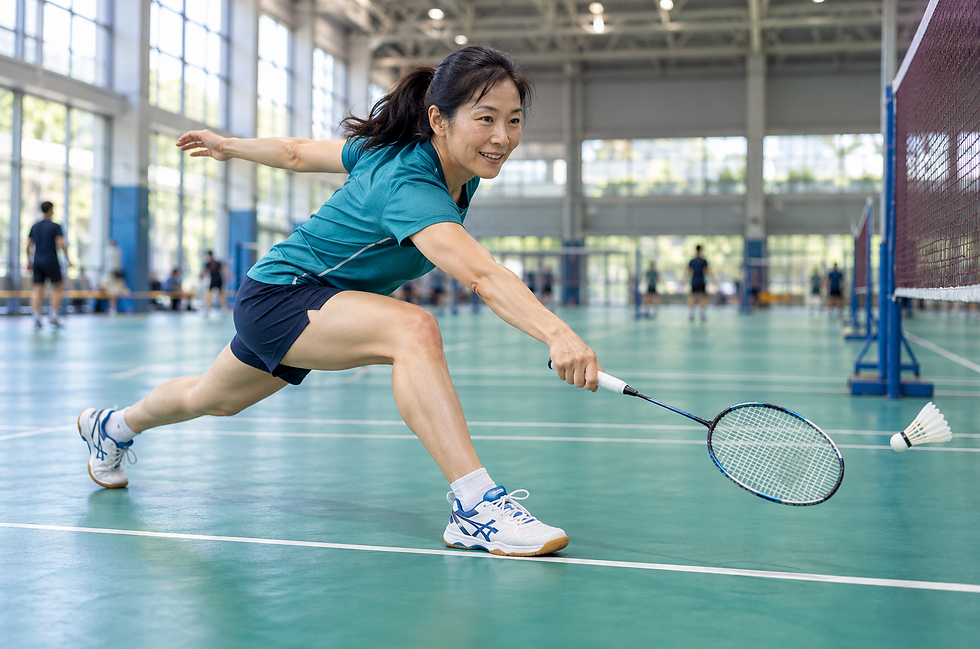
Badminton: Overhead Speed and Lunge Recovery
Overhead clears and smashes require rapid coordination between the trunk, shoulder, arm, and forearm. Deep lunges ask the gluteals, quadriceps, adductors, and calf muscles to accept load and produce the force needed to return for the next shot.
We consider both reaching the shuttle and recovering from that position. Comfortable flexibility alone does not tell us whether you can repeat the movement throughout a match.
Pickleball: Quick Adjustments and Repeated Control
Compact volleys challenge shoulder positioning, forearm control, and repeated gripping. Drives and overheads add greater movement and force demands. Low shots and sudden changes of direction involve coordinated hip, knee, ankle, and trunk movement.
A smaller court still requires preparation for repeated reaching, stopping, and pushing off, particularly during competitive exchanges.
This knowledge makes maintenance care specific to your game. We connect the actions you want to perform with relevant muscle and joint findings, select hands-on treatment, and reassess the movement. The objective is preparation that carries into more comfortable, consistent play.
Maintenance Care as Playing Demands Increase
A weekly doubles game and a tournament weekend ask different things of your body. Adding lessons, playing on consecutive days, or competing in several matches can expose limitations that are less noticeable during occasional play. Maintenance care gives us planned opportunities to assess and treat those limitations as your schedule develops.
We review how you are moving, what becomes difficult during play, and how you recover afterward. Hands-on treatment addresses relevant muscle and joint findings, with reassessment to check the response. Your upcoming games help guide treatment intensity, exercise choices, and timing.
A Schedule Built Around Your Season
Your visit schedule reflects your starting point, previous injuries, playing frequency, and goals. Closer follow-up may be useful when increasing court time, managing a recurring limitation, or preparing for competition. When you are progressing comfortably, appointments can become less frequent.
Racquet sports maintenance appointments are 30 minutes long. This allows time to review your playing response, assess relevant findings, provide manual treatment, and reassess movement. Our usual 15-minute appointments do not provide enough time for this combination, particularly when several muscle groups or joints need attention.
Progress should be recognizable between visits: more comfortable overhead movement, better tolerance to repeated gripping, or greater confidence reaching and recovering during a match. We use that feedback to refine the plan and keep care connected to your game.

Racquet Sports: Assessing the Player, From Grip to Footwork
Your assessment begins with your game: the shots you use, how often you play, and what you want to improve or sustain. Difficulty during one overhead stroke raises a different question from shoulder fatigue after several matches. We examine both the movement and your capacity to repeat it.
Our MSR teaching and clinical care draw on the same anatomical and biomechanical reasoning. We connect specific sporting actions with muscle and joint function, using movement, strength, and functional testing to guide treatment.
Shoulder, Arm, and Hand
We assess shoulder elevation and rotation, rotator-cuff strength, and shoulder-blade movement when reaching or overhead play is demanding. Elbow and wrist movement, forearm strength, and grip tolerance help us investigate difficulty controlling the racquet or paddle.
Your grip, equipment, and playing volume provide context. An elbow complaint during forceful backhands may require different attention from hand fatigue during prolonged pickleball exchanges.
Trunk and Pelvis
Turning for a stroke, preparing an overhead shot, and reaching low require coordinated spinal, pelvic, and hip movement. Assessment may include upper-back rotation, relevant lumbar movement, and abdominal or spinal-muscle strength and endurance.
We distinguish difficulty moving into a position from difficulty controlling or sustaining it. This helps determine whether care should emphasize mobility, manual treatment, physical preparation, or a combination.
Hips, Legs, and Feet
Hip movement, gluteal and thigh strength, ankle mobility, and calf endurance contribute to court coverage. Lunges, step-downs, heel raises, and suitable directional tasks help us examine braking, push-off, and recovery.
We establish meaningful starting points and reassess them. Whether the priority is comfortable serving, repeated gripping, or returning from a deep lunge, the findings should explain what deserves attention and how we will judge progress.

Manual Therapy With a Clear Purpose
Your examination guides where we treat, how we apply treatment, and what we reassess afterward. Motion Specific Release (MSR) combines specific myofascial procedures, addressing muscles and surrounding connective tissues, with joint mobilization or adjustment when appropriate.
Treatment may involve the rotator cuff and forearm muscles for demanding strokes, spinal and hip regions for turning and reaching, or thigh and calf muscles for lunging and recovery. Pressure, positioning, and movement are adapted to your tolerance and upcoming playing schedule.
Considering the Kinetic Chain
A stroke connects movement through the legs, pelvis, trunk, shoulder, and hand. This relationship is called the kinetic chain. Understanding it helps us consider related regions when they influence the action being assessed.
For example, difficulty preparing an overhead shot may involve shoulder movement alongside upper-back rotation. A restricted lunge may warrant attention to hip or ankle mobility as well as the muscles controlling the movement. The examination determines which areas deserve treatment.
Checking What Changes
After treatment, we repeat a relevant movement or loading task. Can you reach more comfortably, turn more freely, or grip with less discomfort? Your response during subsequent games helps us judge whether those improvements carry into play.
In my clinical experience, this cycle of assessment, specific treatment, and follow-up is an important part of useful maintenance care. The purpose is to help you arrive on court better prepared for the demands of your game, with exercise and playing advice supporting progress between visits.

Carrying Improvements Back to the Court
More comfortable movement after treatment creates an opportunity to build on that change. Your exercise plan should develop the strength, endurance, and control needed for the shots and court movements you want to sustain. A few well-chosen exercises are easier to fit around regular play than a lengthy routine.
Depending on your assessment, preparation may include:
Shoulder and arm exercises: Rotation, reaching, and controlled lowering to support repeated strokes, with forearm and grip loading where needed.
Trunk exercises: Turning, reaching, and resisting movement to develop control through different playing positions.
Lower-body exercises: Squats, split squats, calf raises, and lateral steps to prepare for lunging, braking, and recovery.
We progress the relevant movements toward your game, adding speed, repetition, and changes of direction as appropriate. Your coach can help integrate technical practice with this physical preparation.
Playing time also belongs in the plan. Adding lessons, league matches, and a tournament in the same week changes your workload. We consider how these sessions fit together and how you recover between them.
The practical measure of improvement is what carries into play: serving comfortably through a match, recovering confidently from a wide reach, or enjoying several weekly sessions without the same recurring limitation.
Staying Ready for the Game You Enjoy
There is something worth protecting in a regular game: the friendships, the competition, and the satisfaction of getting better. Whether you are preparing for a club tournament or enjoying weekly doubles, you want to arrive ready to participate fully.
Maintenance care brings planned assessment and hands-on treatment into your preparation, with attention to the movements and structures your sport demands. We connect that care with practical exercise and a schedule that responds to your playing season.
In my clinical experience, this ongoing attention can make a meaningful difference to consistency and enjoyment. The goal is more comfortable movement, greater confidence, and the capacity to sustain the games you look forward to.
Call Kinetic Health at 403-241-3772 to book a 30-minute Racquet Sports Maintenance Care appointment. We will help build a plan around your starting point, playing schedule, and goals.
References
Kibler, W. B., Chandler, T. J., Shapiro, R., & Conuel, M. (2007). Muscle activation in coupled scapulohumeral motions in the high performance tennis serve. British Journal of Sports Medicine, 41(11), 745–749. PubMed
Kuntze, G., Mansfield, N., & Sellers, W. (2010). A biomechanical analysis of common lunge tasks in badminton. Journal of Sports Sciences, 28(2), 183–191. PubMed
Myers, B., & Hanks, J. (2024). Hip strength, change of direction, and falls in recreational pickleball players. International Journal of Sports Physical Therapy, 19(9), 1116–1125. PubMed
Reid, M., Elliott, B., & Alderson, J. (2008). Lower-limb coordination and shoulder joint mechanics in the tennis serve. Medicine & Science in Sports & Exercise, 40(2), 308–315. PubMed
Reid, M., & Schneiker, K. (2008). Strength and conditioning in tennis: Current research and practice. Journal of Science and Medicine in Sport, 11(3), 248–256. ScienceDirect
Sakurai, S., & Ohtsuki, T. (2000). Muscle activity and accuracy of performance of the smash stroke in badminton with reference to skill and practice. Journal of Sports Sciences, 18(11), 901–914. PubMed
Related MSR Educational Articles
The following practitioner articles by Dr. Brian Abelson provide the anatomical, assessment, and MSR treatment framework informing this article:

About the Author: Dr. Brian Abelson, DC
Dr. Brian Abelson is a chiropractor, author, and educator with more than 30 years of experience in musculoskeletal care and rehabilitation. He is the developer of Motion Specific Release (MSR) and Clinical Director of Kinetic Health in Calgary.
Medical Disclaimer
The information provided on the Kinetic Health website, including articles, videos, exercises, and other educational resources, is intended for general educational and informational purposes only. It is not a substitute for individualized assessment, diagnosis, or treatment by a qualified healthcare professional.
Musculoskeletal conditions and injuries vary from person to person. Exercises, self-care strategies, or other information presented on this website may not be appropriate for every individual or condition.
If you have new, severe, worsening, or unexplained symptoms, or are unsure whether an exercise or treatment approach is appropriate for you, consult an appropriately qualified healthcare professional.
Use of this website does not establish a practitioner-patient relationship with Kinetic Health or any of its healthcare providers.
For urgent or potentially serious symptoms, seek appropriate medical attention.


Comments